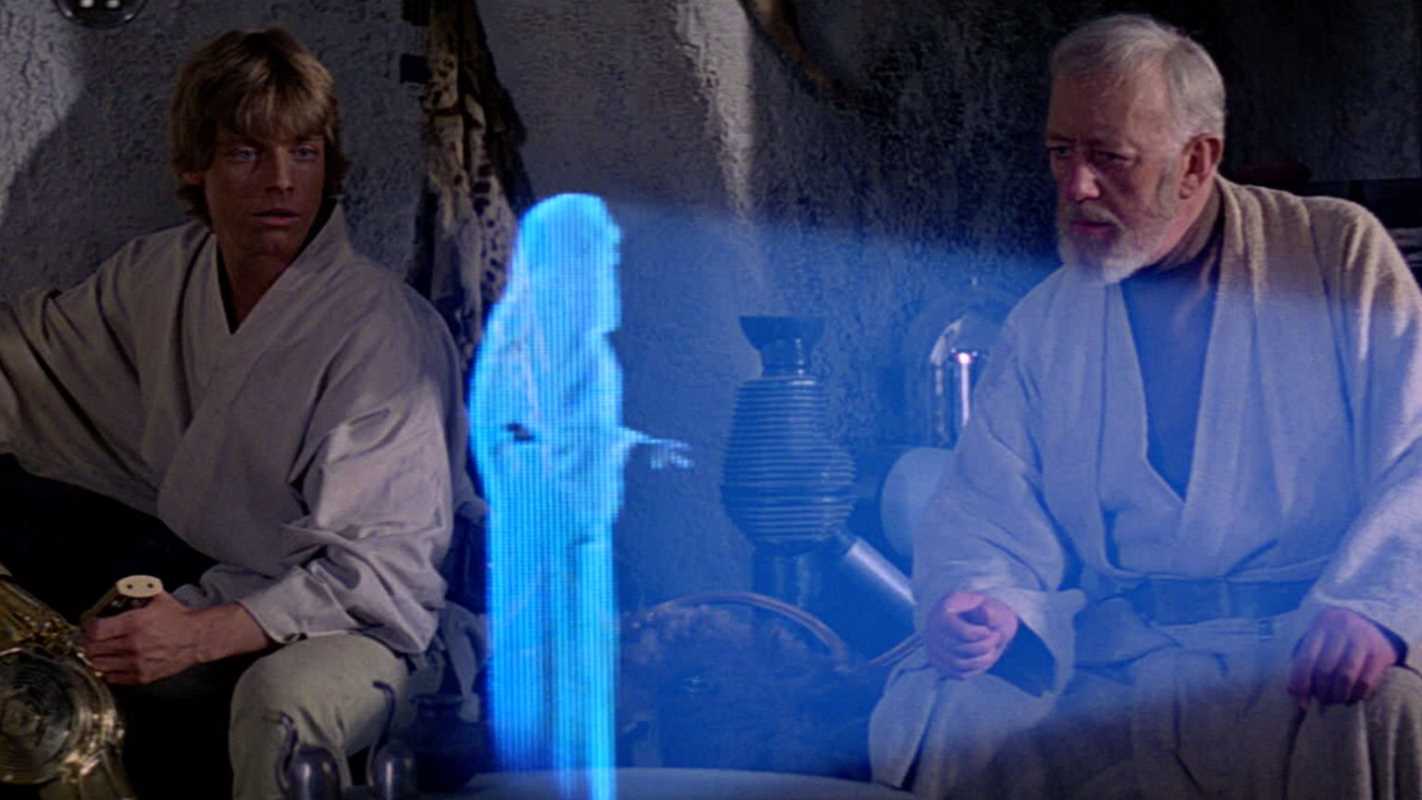
 (Image source: Lucasfilm)
 The shimmering, three-dimensional distress call from Princess Leia in Star Wars has been a defining vision of future technology for generations. It set a benchmark for what a holographic display could be: a free-floating, dynamic image that occupies physical space. For decades, this has remained firmly in the realm of science fiction. But as technology advances, how close are we to making this kind of futuristic communication a reality?
To answer that question, we need to look beyond the silver screen and into the physics of light itself. The science of holography is far more complex than a simple projection, and while we have made significant strides, the path to a true Star Wars-style hologram is fraught with challenges.
What Is a Hologram, Really?
A true hologram is not just a 3D image on a 2D screen or a trick of smoke and mirrors. It is a recording of an entire light field, capturing not just the intensity and color of light rays but also their phase—the specific position of the light waves in their oscillation. This phase information is what allows our brains to perceive depth. When you move your head, a true hologram should reveal different angles of the object, just as a real object would.
The process of creating a traditional hologram involves splitting a laser beam into two. One beam, the reference beam, is directed at a recording medium (like a photographic plate). The other, the object beam, is bounced off the object being recorded. When these two beams meet at the plate, their light waves interfere with each other, creating a complex, microscopic pattern. This interference pattern encodes the full light field of the object. When the developed plate is illuminated again by the reference beam, it reconstructs the original light field, and a three-dimensional image appears.
This principle is the foundation, but creating a moving, full-color, free-floating image requires a massive technological leap beyond a static plate.
Current Advancements: From Peppers's Ghost to Light-Field Displays
Today, what many people call "holograms" are actually clever optical illusions. The most famous is the "Pepper's Ghost" effect, a 19th-century stage trick that uses a sheet of glass or reflective foil to superimpose an image onto a real-world scene. This is the technology behind the concert "performances" of deceased artists. While impressive, these are fundamentally 2D projections, not true holograms.
However, several cutting-edge technologies are pushing the boundaries toward genuine holographic experiences.
- Light-Field Displays: These displays emit light rays in multiple directions from a single screen. By controlling the direction of each ray, they can create a sense of depth and parallax, allowing viewers to see different perspectives as they move. Companies like Looking Glass Factory produce desktop light-field displays that provide a convincing 3D effect without needing special glasses.
- Acoustic Traps and Volumetric Displays: A more futuristic approach involves using focused sound waves to trap and rapidly move a tiny particle in mid-air. By illuminating this fast-moving particle with colored lasers, researchers can "draw" a 3D image in open space. The result is a true volumetric display—an image with physical presence that can be viewed from any angle. While current prototypes can only create small, simple images, the technology proves that free-floating displays are physically possible.
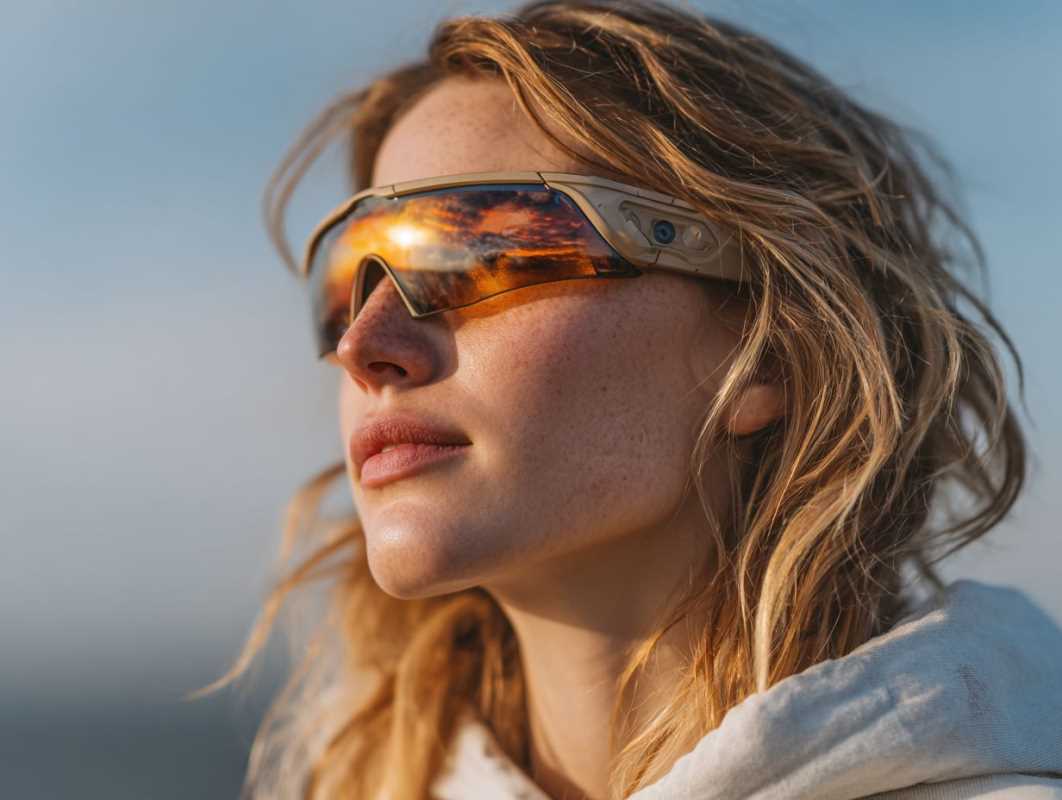
- Holographic Optical Elements (HOEs): These are thin, transparent materials that can manipulate light in specific ways. They are being integrated into augmented reality (AR) glasses to project information directly onto the user's retina. While not creating a hologram in the room, they use holographic principles to overlay digital content onto the real world.
The Major Hurdles to Overcome
So, if the science is understood, what is stopping us from having a holographic video call? The challenges are immense and revolve around computational power, resolution, and physics.
1. The Bandwidth Bottleneck: The amount of information required to generate a dynamic, high-resolution holographic image is staggering. It is exponentially greater than what is needed for a 4K video stream. Capturing, processing, and transmitting this data in real time requires computational power far beyond our current capabilities. Every pixel must be calculated to emit light with the correct phase and direction, a monumental task.
2. The Etendue Problem: A fundamental principle of optics known as "etendue" limits how much light can be focused into a small area from a large source. To create a large, bright, free-floating image, you need a very large and complex optical system. This physical constraint makes it incredibly difficult to build a compact projector that can generate a human-sized hologram in the middle of a room.
3. The Need for a Medium: True free-floating holograms cannot exist in empty air. Light needs something to scatter off for our eyes to see it. Star Wars conveniently ignores this. Real-world solutions, like the acoustic trap displays, require a physical particle. Other concepts involve using contained vapor or plasma as a projection medium, but this means the hologram would be confined to a specific volume, not truly "free-floating."
Real-World Applications Are Already Here
Despite the challenges, less-than-perfect holographic technology is already proving its value in several fields.
- Medicine: Surgeons are using holographic displays to overlay 3D models of a patient's organs onto their body during surgery, providing a kind of "X-ray vision" that improves precision.
- Education: Students can interact with 3D models of complex systems, from molecular structures to ancient artifacts, making learning more immersive and intuitive.
- Engineering and Design: Automotive designers and architects can visualize their creations as full-scale 3D models, allowing them to collaborate and iterate on designs in a more natural way.
The Verdict: How Close Are We?
We are simultaneously very close and very far away. We have cracked the fundamental science, and early versions of the technology are already transforming industries. Tabletop light-field displays and AR headsets provide a window into what the future of 3D interaction will look like.